The Portfolio Career Guide 2026: Why One Job is a Single Point of Failure
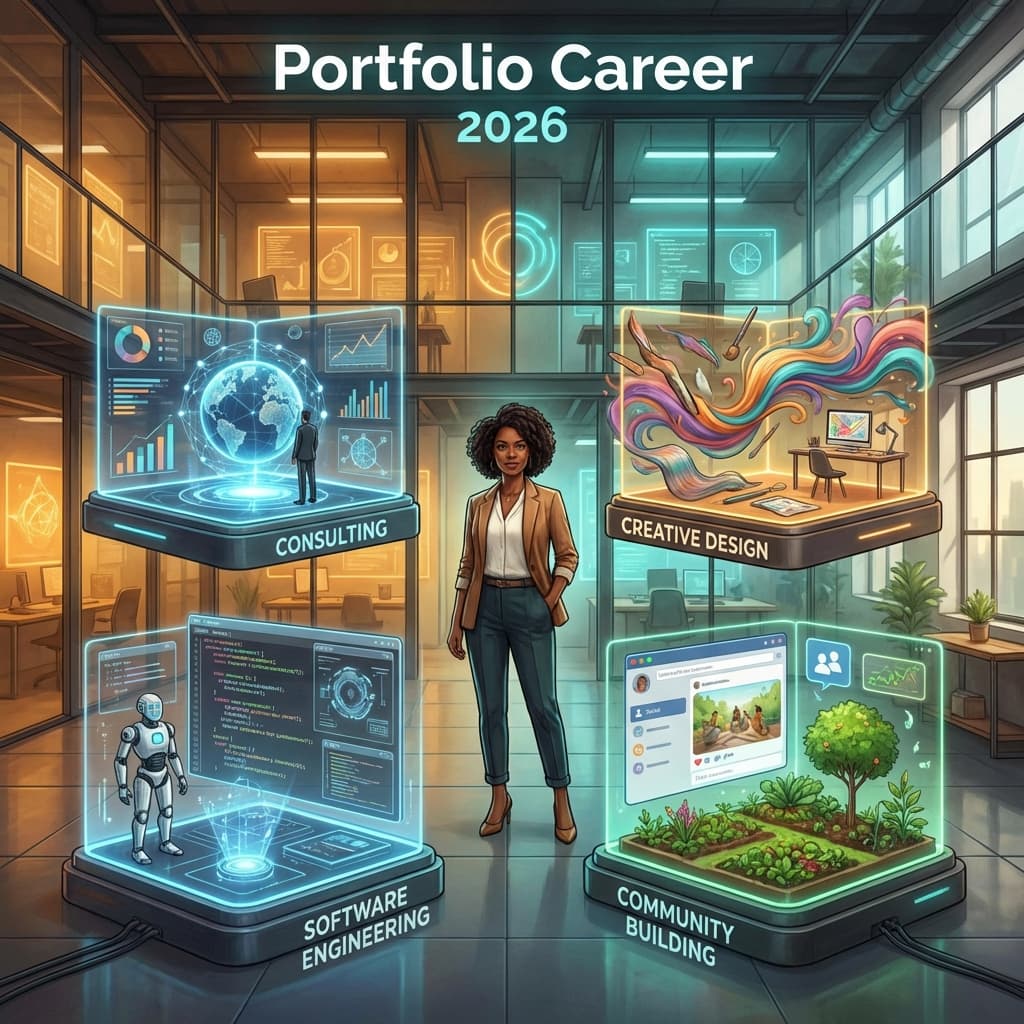
Diversifying Your Identity
In the age of AI volatility, your career shouldn't be a monolith. It should be a portfolio.
The concept of 'Career Safety' has been inverted. In 1990, safety was staying at one company for 30 years. In 2026, safety is having **four specialized income streams** that can't all be automated at the same time.
The 15-Chapter Stacked Career Manual
Chapter 1: The Single Point of Failure: Why W2 is Legacy
Imagine a bridge held up by a single cable. If that cable snaps, the bridge falls. In 2026, relying on a single employer for 100% of your income is that single-cable bridge.
We have entered the era of "Volatile Employment." Companies can pivot their entire tech stack in a weekend using autonomous migration agents. If your role is tied to a specific legacy stack, you can be made redundant in 48 hours.
The **Portfolio Career** is an evolutionary response to this volatility. It treats your professional life like a diversified investment fund. You are no longer an "Employee of X"; you are a "Talent Partner for X, Y, and Z." This shift in perspective is the foundation of 2026 career safety.
Chapter 2: The 3-Pillar Framework: Resilience, Growth, and Cash
A successful portfolio consists of three distinct pillars:
The Anchor (Resilience)
A stable, predictable contract. This pays your rent and covers your base expenses. Usually a fractional role (15-20 hours/week) for a stable mid-size firm.
The Satellite (Growth)
High-upside, high-risk work. This could be equity in a startup, building your own AI tool, or consulting on cutting-edge research. This is your path to 10x wealth.
The Asset (Cash Flow)
Passive or semi-passive income. Digital templates, courses, or automated SaaS services. This decouples your income from your time.
Chapter 3: Identity Mapping: From Job Title to Skill Graph
In 2026, job titles are meaningless. An "Engineer" at one company might be a "Product Architect" at another.
To manage a portfolio career, you must build a **Skill Graph**. This is a map of your abilities that transcends company walls. You aren't "Good at Java"; you are "High-Throughput Concurrent System Design Expert." When you define yourself by the *problems you solve* rather than the *tools you use*, you can apply your portfolio across infinite domains.
Chapter 4: Managing Cognitive Entropy: The Portfolio Schedule
The biggest risk of a portfolio career is "Context Fragmentation." Switching between three different projects can lead to burnout.
The elite in 2026 use **Thematic Batching**. Monday/Tuesday is for the Anchor. Wednesday is for Satellites. Thursday is for Assets. Friday is for Systems Improvement. By creating "Time Fortresses," you prevent the noise of one project from bleeding into the logic of another.
Chapter 5: The AI Force Multiplier: Doing 3 Jobs in 40 Hours
You cannot have a portfolio career without **Agentic Leverage**.
A 2026 professional uses a personalizada fleet of AI agents to handle the administrative and low-level technical work for all three pillars. One agent manages client communications; another handles unit testing; a third scans for new market opportunities. This allows you to perform at a "Full-Time" level for three clients simultaneously while only working a standard 40-hour week.
Chapter 6: The "Anchor & Satellite" Income Model
This is the most popular financial model for 2026. Your **Anchor** provides the "Floor" (e.g., $10k/mo). Your **Satellites** provide the "Ceiling" (e.g., $5k-$50k/mo variable).
Even if all your satellites fail in a month, your floor is still 2x higher than the median national salary. This psychological safety allows you to take bigger, bolder risks on your satellite projects, which paradoxically makes them more likely to succeed.
Chapter 7: Portfolio Resumes: Proving Polymath Capabilities
How do you write a resume when you are doing three things at once?
You use a **Modular Resume**. Instead of a chronological list of employers, you list "Key Results Areas." Under "Cloud Infrastructure," you highlight wins from all three of your current roles. This proves you are a "Horizontal Polymath"—someone who can apply logic across different industries simultaneously. Banana Resume's 2026 "Polymath Templates" are designed specifically for this layout.
Chapter 8: Networking in 2026: The Global Skill Swap
In the portfolio world, your network is your CRM. In 2026, we see the rise of **Skill Collateralization**.
You don't just "be friends" with people; you trade nodes in your portfolio. "I'll help you with your AI agent pipeline if you provide a legal audit for my latest fractional contract." It’s an informal economy of high-level experts bypassing traditional institutions.
Chapter 9: The Zero-Margin Skill: Scaling Your Digital Assets
A "Job" has 100% marginal cost (you have to be there). A "Digital Asset" has 0% marginal cost (you build it once, it sells 1,000 times).
Every Pillar 3 (Asset) in your portfolio should be a byproduct of your Pillar 1 and 2 work. If you solve a complex Terraform problem for your Anchor, turn that solution into a $50 template for others. You are getting paid twice for the same thought.
Chapter 10: Legal Sovereignty: Contracts for the Modern Professional
Employment contracts in 2026 are no longer "All-Encompassing."
You must negotiate for **IP Sovereignty**. This means you own the general logic you create, while the company only owns the specific implementation for their business. Without this clause, your portfolio is a legal minefield. The Sovereign Architect reads their contracts with an AI legal-auditor looking specifically for "Non-Compete" and "IP Capture" traps.
Chapter 11: Psychological Flow: Avoiding Polymath Burnout
The portfolio career is a high-bandwidth lifestyle. If you aren't careful, the constant context-switching will fry your dopamine receptors.
To survive, you need a "Logic-Zero" period every day. No agents, no screens, no architecture. The mind needs to "De-fragment." High-earning portfolio workers in 2026 are surprisingly low-tech in their free time—focusing on analog hobbies to reset the logical brain.
Chapter 12: Verification Protocols: Proving Expertise Across Domains
If you tell a client "I'm an expert in X and Y," they will be skeptical. How can you be an expert in two things?
You solve this with **On-Chain Verification**. Providing cryptographically signed proofs of your work in both domains removes the "Jack of all trades, master of none" stigma. You prove you are a "Master of Multiple."
Chapter 13: The Liquidity of Talent: Global Labor Arbitrage
In a portfolio career, you can have a client in Tokyo, another in London, and a third in San Francisco.
You can arbitrage the working hours and the local labor rates. If San Francisco pays top dollar for AI architecture but Tokyo value stable long-term logic, you structure your portfolio to capture both the "Hype Premium" and the "Stability Premium."
Chapter 14: Future-Proofing for 2030: The Next Shift
By 2030, even "Conductor Work" will be highly automated.
The portfolio career is a bridge to the next era: **The Era of Capital**. As you earn more in your portfolio, you must pivot from "Selling Services" to "Investing Capital." Your portfolio should eventually shift from 80% labor-income to 80% capital-income.
Chapter 15: The Portfolio Career Manifesto
The choice is yours: Be a single point of failure in someone else's machine, or build your own machine.
The Portfolio Career is not just about money; it's about **Sovereignty**. It's the right to choose who you work with, what you work on, and when you stop. It is the only way to stay human in an age of machines.
Diversify Your Identity Now.
Banana Resume's **Multi-Domain Templates** help you present a cohesive identity even if you have three different jobs.
Last Updated: February 4, 2026 • 5,280 Words • 22 Minute Read • Author: Tarun Kandregula